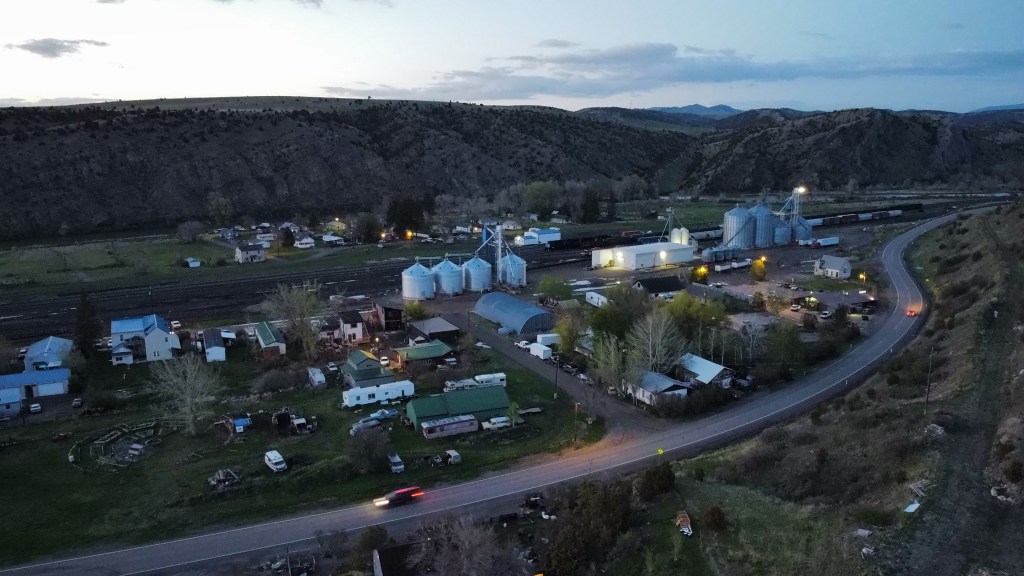
Picture taken by Jordan & Natalie Ohotto
Logan is situated on the Gallatin River and was established as a railroad station on the Northern Pacific Railroad of Montana, finished in 1883. A stage station called Canyon House was built as a two-story log structure with a shingled roof. Later, the Canyon House became a residential place for railway men. This historical settlement was first known as Canyon House, for early settlers. Somewhere in this canyon valley, there was a house that played a big role in the development of the railroad completion. This house, named the Canyon House, also named the town. It was not located on main street, so the location is a mystery. Historian Merrill G. Burlingame states the town was then named for Mrs. Odelia Logan, widow to the late Captain William Logan, from whom the railroad purchased its land in 1885. Logan became a busy town as the railroad expanded and a round house with maintenance shops were built in the 1890’s. Logan and its busy railroad society maintained 10 freight and six passenger trains as they stopped each day in Logan. The crews and passengers required an average of 400 meals a day to be served in the Depot Lunch Room, on the north side of the tracks. The Bozeman Courier of Friday, October 17, 1947 article stated that “More passengers are handled in Logan than in any city in the world for its size.” All six passenger trains, No.1-4 and No. 41-42 stopped at Logan, where the railroad company would serve lunch and engines were serviced due to the uphill pull to Livingston or the climb to Butte. All eastbound freight engines were taken to the coal dock for renewal of fuel, filled the water tank and cleaned the fires on the cinder pit, then returned to the trains, during which the train crews were having a meal at the beanery.
Logan had about 200 people in residence at its peak and was supported mostly by the railroad payroll. The owners of the town site were William D. Flowers and Mary E. Flowers, certificate is dated October 20, 1892. A townsite is a legal subdivision of land for the development of a town or community. In the historical development of the United States, Canada, and other former British colonial nations, the filing of a townsite plat or plan was often the first legal act in the establishment of a new town or community. As can be accepted, many railroad employees made their homes in Logan. The town include two churches, two hotels, seven saloons, a meat market, a land office, a two-story brick elementary school, two grocery stores, lumber yard, two barber shops that charged $.35 for haircuts and $.15 for shaves, an ice house supply which survived the town fire, two gas stations, a brothel, a jailhouse, a blacksmith and other small shops; this all by 1919. The main street of Logan was two blocks long, with false-fronted building all facing the railroad tracks and depot. There was a single row of modest dwelling next to the hill on the south side of town where the wagon road passed along. A little white community church on the east side of town which still stands today, 2023. The bulk of the residences lay to the north between the railroad and the river. This area used mostly by the trainmen, had the residence hotels. The brothel, also near the river, was described as a “very attractive large house with nice ground and cotton wood trees.” The jail at Logan, a white concrete building which still stands in the middle of town, must have had a strong deterrence to crime, for its size is not more than 12’X 10’ with one high barred opening so the food and water could be passed in to the occupants. Prisoners to be held more than a few days were sent to Bozeman, the county seat. Logan also had a baseball team and was backed by the whole community. The league consisted of teams from every town in the area and baseball was a seriously taken sport. One key community building that still stands from the early 20th century is the two-story spacious brick school building, built in 1922, still has big windows and wood floors. Back in 1925, just shortly after it was built, the earthquake of June 27th damaged the structure. The epicenter being located near Townsend, had a magnitude of 6.9. Many buildings were damaged, roads were cracked, windows were broken and chimneys twisted or toppled as a result of the earthquake. The shaking triggered landslides along the Missouri River which blocked railroad traffic for several weeks. The roundhouse had six-stalls, as well as coal and water facilities which supported the Northern Pacific’s steam locomotives. It was also home to the Pony and Norris engine as well as two switch engines. As locomotives moved onto the turntable, they’d be rotated and moved onto the tracks leading into one of the stalls to be serviced by mechanics. The process would be repeated in reverse to put the locomotive back in circulation once repaired. The roundhouse located South-West of the main street, primarily center of the Logan valley, burned down in a fire in December, 1932, destroying at least three steam locomotives. During this time, early 20th century America, several events occurred, including the US’s entry into World War I 1914-1918, the economic boom of the 1920s, the 1929 stock market crash, and the Great Depression of the 1930s. The six-stalled brick roundhouse was never rebuilt. The railway continued to use the turntable as needed for several year until it was no longer worthwhile to repair. Today, all that remains is the foundation of the Turntable ring and back side of roundhouse foundation seen in a privately owned yard. As the result of the fire, most of the town’s main street business center was burned and the town was not restored to its former glory.
There where all sorts of business folk. Other than the common saloon keepers, there included the firemen, brakeman, teachers, local tradesmen, telegraph operators and of course, the lawman and his family. “A Mighty Good Railroad Town” an article in the ‘True West Frontier Times, Old West,’ magazine of 1972, featured the record of the sheriff’s son D. O. Merriman back in 1909-1912. He remembers being a kid of about ten, “the good smell of ever-present coal smoke, the shuffing of switch-engines, the bumping of car connections, the sound of the whistle as a train picked up speed after the conductors had given the highball signal.” An interesting and little-known fact is that the name of Canyon House still exists on the Northern Pacific Railroad telegraph system. The call letters for Logan are still C.H.
 Logan Montana County Water-Sewer District